LBC journalist’s brother kidnapped for ransom

(ZAHLE, LEBANON) — The brother of a Lebanese journalist based in Zahle, Lebanon has been kidnapped for ransom on Friday, according to LBCI TV reports.

“The abductors of the young man Khodr Farouq Darwish, whose car was found in Baalbek’s al-Taybeh, have called his family and asked for a $135,000 ransom,” the network said.

Earlier in the day, family members told the state-run National News Agency that Khodr, whose brother is LBC’s reporter Nayef Darwish, lost contact with the 30-year-old man on Thursday.

Darwish’s Jeep Grand Cherokee was found in the Baalbek town of al-Taybeh near the market, NNA said.

His father, Farouq, told the agency that his son was in contact with a woman and was heading to Baalbek on Thursday.

Darwish’s family members blocked the main road in Furzol, in the qada of Zahle, demanding that the state secure his release.

There has a been a rise in kidnappings in the Bekaa Valley over the last few years, with gangs increasingly taking advantage of the lack of stability due to the Syrian war to kidnap people and then demand a ransom.

Mother of murdered U.S. journalist ‘never prouder’

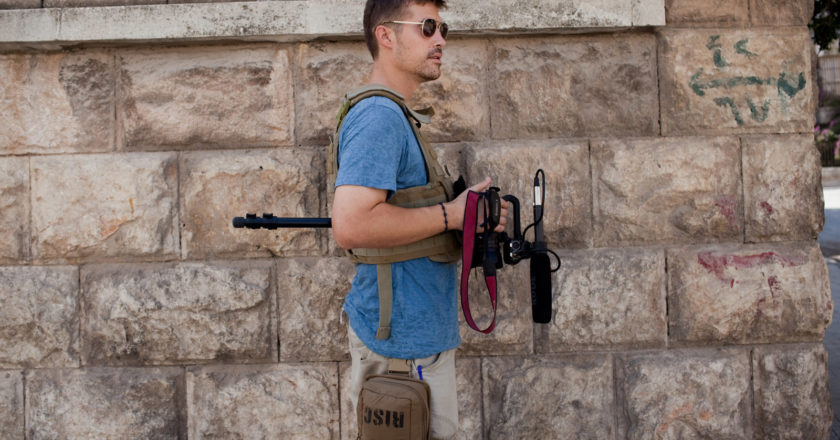
(WASHINGTON, DC) — The mother of American journalist James Foley, apparently executed by Islamic State of Iraq and Greater Syria (ISIS) jihadists, Wednesday paid tribute to her son who she said had died trying to expose the suffering of the Syrian people.

Condolences and shocked messages poured in after the Islamist group released a video showing a masked militant beheading a man resembling Foley, who has been missing since he was seized in Syria in November 2012.

“We have never been prouder of our son Jim. He gave his life trying to expose the world to the suffering of the Syrian people,” Foley’s mother Diane said in a Facebook message to supporters.

“We implore the kidnappers to spare the lives of the remaining hostages. Like Jim, they are innocents. They have no control over American government policy in Iraq, Syria or anywhere in the world.”

“We thank Jim for all the joy he gave us. He was an extraordinary son, brother, journalist and person.”

A second captive, said to be U.S. reporter Steven Sotloff, was shown alive in the video, along with a warning that his fate rests on U.S. President Barack Obama ordering a halt to strikes against the jihadist group which seized swath of Syria and Iraq.

Sotloff, whose kidnapping in August last year has not been widely reported, has written for several U.S. newspapers and magazines, including Time, Foreign Policy and The Christian Science Monitor.

The White House said U.S. intelligence was studying the video.

President Barack Obama says the United States will continue to confront Islamic State extremists despite the brutal murder of journalist James Foley.

Speaking from Matha’s Vineyeard where he’s vacationing with his family, Obama says the entire world is “appalled” by Foley’s killing. The president says he spoke Wednesday with Foley’s family and offered condolences.

Obama says the Islamic State abducts women and children, and tortures, rapes, enslaves and kills people. He said the Islamic State targets Christians and other minorities and aims to commit genocide.

Lebanese journalist found dead in Jordan

(AMMAN, JORDAN) — Jordanian police announced that it has discovered the body of Lebanese journalist Mazen Diab at his house in the capital Amman on Friday.

“Security forces found the body of Diab tied with ropes inside his apartment,” Jordanian news agency ZAD said, noting that his house is located on Mecca Street in Amman. “Security bodies have launched an investigation in this matter and are listening to the testimonies of the slain journalist’s neighbors.”

The neighbors confirmed that Diab was stabbed repeatedly, according to the same source.

“Investigation is ongoing to uncover all circumstances surrounding his death,” a security source told al-Ghad.

The body of Diab was referred to a forensic doctor to determine the causes of death, noted ZAD.

Jordanian authorities said Saturday that they had arrested four people who confessed to killing Diab.

In a statement, Jordan’s General Security said the coronary’s report indicated that the cause of Diab’s death was an internal bleeding after the victim was hit with a sharp object.

The Lebanese citizen’s death was discovered after a friend visited his house and repeatedly knocked on the door and called him, but failed to reach him.

“He then took off the door of the house with force and discovered Diab’s body,” the informed source told al-Ghad.

Diab, 31, presented a program on Jordan’s Sawt al-Ghad radio station before his death. He suffered from lung cancer and had underwent an operation to remove a part of his lungs a year ago.

He graduated from Studio al-Fan talent show in 2002 when he applied to become a TV journalist, and earned a graduate degree from the Beirut Arab University.

ABC News issues apology after mistaking suffering Palestinians for Israelis

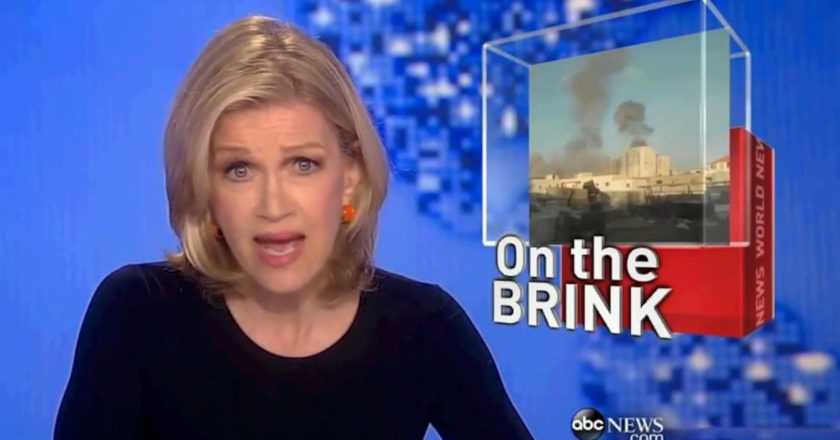
Diane-Sawyer-Israel-Palestinian-Family(NEW YORK, NY) — On July 8, ABC World News anchor Diane Sawyer gave viewers the latest on the violence in the Gaza Strip–by stressing the threat to Israel:

We take you overseas now to the rockets raining down on Israel…. And here an Israeli family trying to salvage what they can, one woman standing speechless among the ruins.

Sawyer’s narration accompanied these images:

abc-gaza
abc-speechless-gaza

One problem: Neither of those images is an “Israeli family.” Both photos are from the Gaza Strip, and capture the aftermath of Israeli attacks.

Many people caught the mistake, including Yousef Munayyer of the Palestine Center, which posted a video of ABC’s embarrassing mistake:

Finally, ABC posted this statement (7/10/14) early this morning:

“On Tuesday night “World News” aired a report on the conflict between the Palestinians and Israelis, including attacks from both sides. In the introduction to the story, we mistakenly identified a family depicted in a still photo. They are Palestinian, not Israeli. We regret the error and will correct it.”

So an honest mistake, right? That’s one way of looking at it.

But there’s a pretty well-established pattern of corporate media trying to paint the conflict as between equals, a type of false balance that treats the threats to Israeli lives and Palestinians lives as similar. But at times it’s much more than that; this ABC report, and others like it, foreground the fear that Israelis are dealing with as sirens warn of incoming rockets from Gaza. “Running in terror as sirens wail” is how ABC correspondent Alex Marquardt began the segment right after Sawyer’s introduction. He conveyed Israel’s view of the conflict before shifting to life in Gaza.

At this point, the rockets targeting Israel have done very little damage. There are no reported Israeli deaths. But the fact that dozens of Palestinians had died, including several children, by the time ABC aired its report apparently did not cause them to consider this more newsworthy than Israeli fear.

The rocket attacks on Israel are treated as being more fundamentally important than the attacks being launched on Gaza. Sawyer’s introduction at the top of the broadcast was this: “On the brink: Rockets raining down on Israel. The Israelis trying to blast them out of the sky. And our reporter is there on the front lines.”

With that kind of set up, a newscast is bound to believe that the destruction they’re showing viewers must be in Israel–even though anyone who’s actually followed this story would know that the images show a level of destruction that is only happening in Gaza.

That’s why ABC’s error should be seen less as a simple mistake, and more as a reflection of a worldview.

Source: Peter Hart Fairness & Accuracy in Reporting

Original Article

Reposted via Creative Commons Attribution- Non-Commercial

Journalists from Egypt, Tunisia and Syria win the 2014 Samir Kassir Award

BEIRUT: The EU Special Representative for Human Rights Monday said the freedom of expression and freedom of the media were two essential prerequisites for active and engaged citizenry.

“Without freedom of expression and freedom of the media, an informed, active and engaged citizenry is impossible,” Stavros Lambrinidis said during the annual ceremony for the Samir Kassir Award for Freedom of the Press in Beirut.

Lambrinidis highlighted how freedom of expression online and offline was essential for the fulfilment and enjoyment of a wide range of other human rights, including freedom of association and assembly, freedom of thought, religion or belief, the right to education, the right to take part in cultural life, the right to vote and all other political rights related to participation in public affairs.

The Samir Kassir Award for Freedom of the Press is granted by the European Union, and rewards journalists who have distinguished themselves through the quality of their work and their commitment to human rights and democracy.

Organised every year since 2006, the Samir Kassir Award honours the memory of Lebanese journalist Samir Kassir who was assassinated on 2 June 2005 in Beirut.

As in previous years, an independent jury selected the winners. It comprised seven personalities from Europe and the Middle East. The award ceremony was hosted by Mona Wehbi, journalist at Al-Hurra TV.

The Head of the Delegation of the European Union to Lebanon, Ambassador Angelina Eichhorst, underlined that “the yearly edition of this unique award is a tangible proof of the EU’s unwavering support to freedom of expression as a key element of deep democracy.”

“Journalists pay a high price to expose abuses and raise awareness about violations of fundamental rights,” Eichhorst continued. “Rewarding excellence in journalism needs to be distinguished because our ability to act as informed citizens of the world also depends on media that can work freely and safely.”

The three winners of the 2014 edition, each of whom received awards worth €10 000, included print journalists Hanene Zbiss from Tunisia and Mohamed Abo El-Ghit from Egypt and Syrian journalist and filmmaker Orwa Mokdad.

El-Ghit published his article “Season of the living dead” in renowned Egyptian Al-Shorouk newspaper on January 3, 2014. In his article, El-Ghit described the violent clashes that opposed, before the ouster of former Egyptian President Mohamed Morsi, supporters and opponents of the Muslim Brotherhood.

“He deplores the “herd” mentality that pushed people from both sides to resort to the worst levels of violence,” according to a statement issued by the EU delegation.

As for Hanene Zbiss, she published her investigative report “Quranic kindergartens in Tunisia” in the magazine “Réalités” (Realities) on October 10, 2013. Her article describes how Tunisia has witnessed, since the January 2011 uprising, the proliferation of so-called “Quranic kindergartens,” established by religious associations.

Syrian journalist and film maker Orwa Mokdad won an award for his audiovisual report titled “Syrian Music.” Mokdad’s work depicts how the Syrian war affected young Syrian singers and musicians living in Beirut and their struggle to combat violence through art.


Source: The Daily Star

Original Article

Send this to friend