
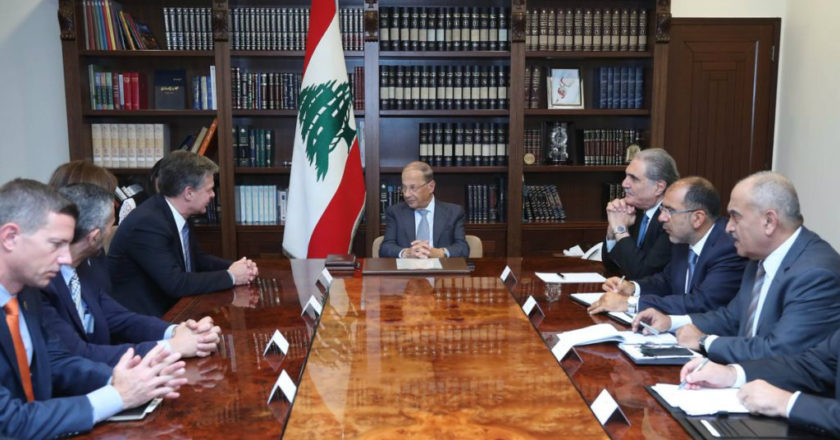
FBI director meets with Lebanon’s President Michel Aoun

FBI Director Christopher Wray and several U.S. officials visited with Lebanon’s President Michel Aoun at the country’s presidential palace in Baabda.

In a statement, Aoun said Lebanon was thankful for U.S. support to the Lebanese Armed Forces. He said Wray expressed his support to the Lebanese army for helping to fight militant groups across the country.

“Wray visited Lebanon to reaffirm the U.S. government’s commitment to the Lebanese-American partnership,” Aoun said in a statement released by the state-run Lebanese National News Agency. “They discussed issues relating to the close law enforcement and security cooperation between the United States and Lebanon.”

FBI Director Christopher Wray visited with Lebanon's President Michel Aoun at the presidential palace in Baabda. (Lebanese National News Agency)
FBI Director Christopher Wray visited with Lebanon’s President Michel Aoun at the presidential palace in Baabda. (Lebanese National News Agency)

The meeting was attended by U.S. Ambassador to Lebanon Elizabeth Richard, and representatives from the offices of Prime Minister Saad Hariri and Parliament Speaker Nabih Berri.

“Lebanon is a key partner on law enforcement, including the fight against terrorism and the preservation of cultural heritage through preventing antiquities trafficking,” Aoun added. “Director Wray’s visit highlights the importance that the United States places on its relationship with Lebanon, and our continued commitment to the security of both the United States and Lebanon.”

The U.S. has provided more than $1 billion in military assistance to Lebanon since 2006, according to the Associated Press.

Christopher Wray formally replaced former FBI head James Comey in September 2017.

WATCH: FBI Director Christopher Wray meets with President Michel Aoun in Lebanon:
Lebanese Forces, Kataeb and PSP call on Aoun to nullify citizenship decree

The Lebanese Forces, Progressive Socialist Party, and Kataeb Party issued a joint statement urging Lebanese President Michel Aoun to nullify his controversial decree granting Lebanese citizenship to over 400 foreigners.

The decree grants Lebanese nationality to mostly wealthy Syrians, some of which are considered close to the Syrian regime, the Daily Star reports.

In the statement, the parties called on the President to “abrogate the decree” and later added that a reasonable decree would include special cases only.

lf kataeb psp

“(A reasonable decree) includes people with very special cases and have specific humanitarian conditions that are consistent with the Lebanese Constitution provisions and the criteria for granting the Lebanese citizenship,” the statement added.

Kataeb MP Sami Gemayel requested the Lebanese Interior Minister release “full text and names” so that “we can study it and give an opinion about it in order to take any legal or constitutional steps we need to.”

Lebanese Foreign Minister-elect Gebran Bassil defended the naturalization decree, saying the President and the foreign ministry are “not involved in any suspicious acts regarding the controversial naturalization decree,” wires reported.

Although Saad Hariri is a part of the March 14 alliance with the LF, PSP and Kataeb, he sided with Aoun and signed the controversial decree into law.

Lebanese leaders react to London Bridge terror attack

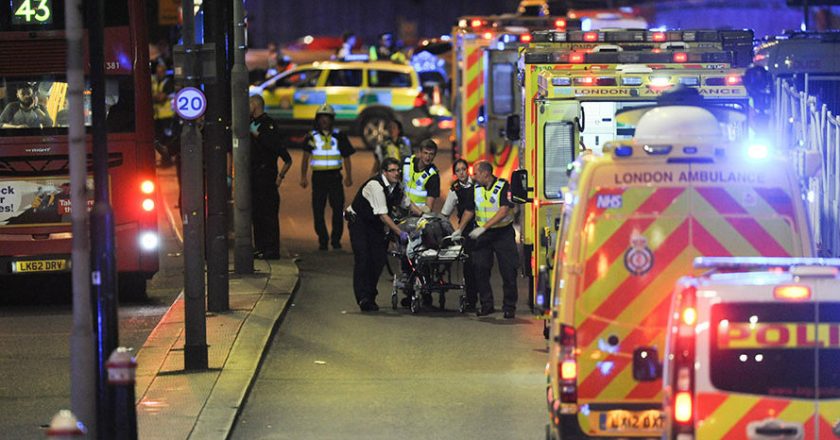
Lebanese political leaders submitted their reactions to the Lebanese National News Agency Sunday in response to the terror attack at the London Bridge.

ISIS has claimed responsibility for the attack Saturday night that killed 7 people and injured at least 48 others. At least 21 people are in critical condition at the hospital, officials said.

London security officials said 12 people have been arrested in connection with the attack. Police are also executing raids in parts of London as of Sunday night.

READ: Statements from Lebanese political leaders:

President Michel Aoun

michel-aoun-reacts-to-london-attacks

“Targeting Britain repeatedly with brutal attacks indicates that it still stands in the face of dark and inhuman ideologies represented by terrorism, which is desperately trying to circulate them as an alternative culture to the dialogue of civilizations and religions. The Lebanese stand in solidarity with Britain in fending off all kinds of terrorism.”

Speaker Nabih Berri

nabih-berri-reacts-to-london-attacks

“We reaffirm our strong condemnation of the terrorist acts that targeted London Bridge and Boro Market, which resulted in the death and injury of a large number of innocent civilians.”

Prime Minister Saad Hariri

saad-hariri-reacts-to-london-attacks

“There are always attempts to link Islam to terrorism. Islam is innocent of these terrorist acts.”

MP Walid Jumblatt

walid-jumblatt-reacts-to-london-attacks

“I hope the foundations of Western democracy would remain firm and strong, since it reflects the values of freedom and human rights regardless of its positions vis-à-vis various issues. I deplore this terrorist act and extend my condolences and sympathy to the British Government, the British people and the victims’ families.

We will update statements as they become available.

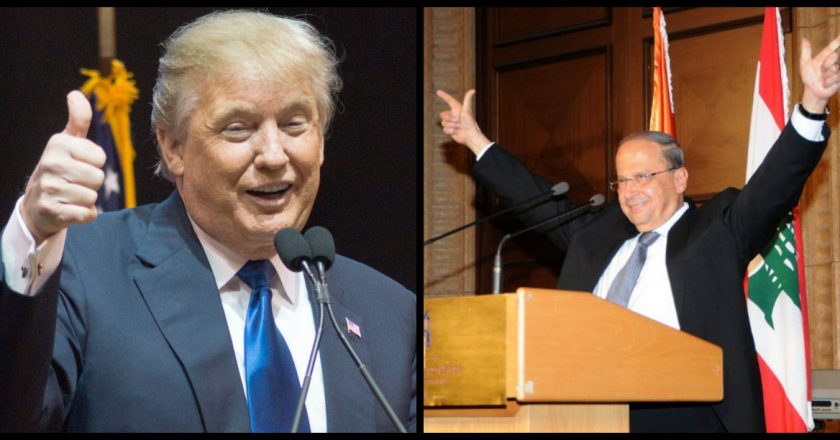
Aoun: Trump’s election is a ‘bright hallmark’

President Michel Aoun congratulated U.S. President-elect Donald Trump last week and called his election a “bright hallmark in the history of democracy.”

“Your election restores the people’s will in choosing their rulers,” Aoun wrote in a letter to President-elect Trump. “This is a new chance for Lebanon and the U.S. to boost their bilateral cooperation.”

Aoun said he hopes a Trump administration will build strong ties with the Mediterranean country.

“It’s a (new chance) for the sake of achieving peace in the Middle East, confronting terrorism, and putting an end to wars and violence through peaceful means,” Aoun added.

Aoun’s senior advisor and president of the Free Patriotic Movement, Gebran Bassil, compared Trump’s unprecedented victory to Aoun’s victory. Aoun was elected president eight days before the U.S. election.

“9/11” represents the terrorist attacks in New York on Sept. 11, 2001, while “11/9” represents the day Trump was elected U.S. president. “13/10” represents the onset of the military occupation of Syria and Aoun’s defeat, while “31/10” is the day Aoun was elected president.

MP Alain Aoun also compared the elections on Twitter, posting: “Two unconventional presidential candidates opposed by the traditional political class have won the elections thanks to popular will.”

He later deleted the tweet, and said it was misinterpreted.

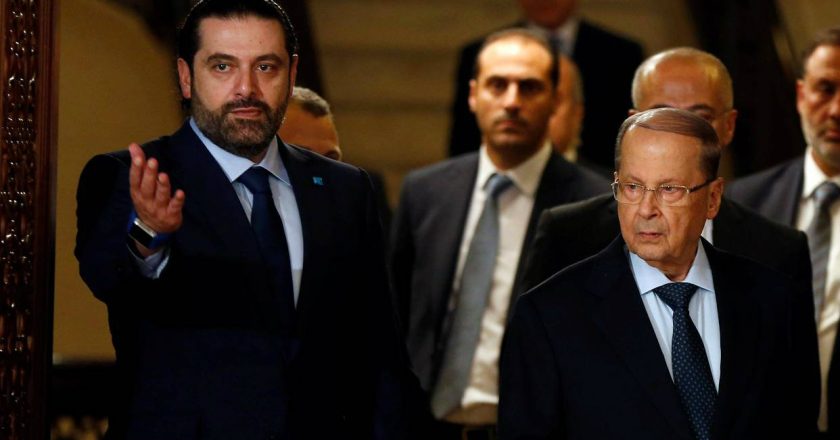
Saad Hariri named Lebanon’s new prime minister

(BEIRUT) – Lebanon’s two major parliamentary blocs on Tuesday named Saad Hariri, a former prime minister and a Sunni leader, as their candidate for premier in the government being formed after a new president was elected.

The widely expected endorsement by the Future bloc, led by Hariri, and the majority Christian bloc comes a day after Michel Aoun was elected president. Hariri was promised the post in exchange for backing Aoun’s presidential bid in parliament, ending a two-and-half-year deadlock that left Lebanon without a president.

Aoun is receiving the different parliamentary blocs Wednesday before naming the prime minister, likely before the weekend.

In the country’s sectarian-based political system, the prime minister, always a Sunni, is likely to face a daunting job, balancing different and often rival groups, to form a new Cabinet.

Gebran Bassil, who heads the Free Patriotic Movement of Aoun, said they back Hariri’s nomination for the premier post.

“We accept whoever accepts us. All our votes will go to Hariri because he recognized us and we will side with him in all the difficulties he will face,” Bassil told reporters.

Lebanon has been without a head of state since May 2014. According to the power sharing system governing Lebanese politics since the 1990s, the president must be a Maronite Christian.

Parliament failed in 45 different sessions to vote for a president, amid political infighting and boycotts, before Monday’s election of Aoun. Hariri’s about-face in support of Aoun last month broke the deadlock and changed the political landscape in Lebanon, bringing old-time foes on the same side, while allies differed.

Hariri, 46, served as prime minister briefly between late 2009 and 2011, when his government was brought down by powerful Lebanese Hezbollah group, now a major Aoun backer. He since left Lebanon, and was a vocal critic of Hezbollah. He returned earlier this year, sounding a more conciliatory tone.

Hariri is the son of late Prime Minister Rafik Hariri, who was assassinated in February 2005 with massive bomb on a Beirut seaside street.

The U.N. Security Council welcomed Aoun’s election as “a long-awaited and critical step to overcome Lebanon’s political and institutional crisis.” It urged the new president to promote the country’s stability and swiftly form a unity government and elect a parliament by May 2017, saying these steps “are critical for Lebanon’s stability and resilience to withstand regional challenges.”

U.S. State Department spokesman John Kirby told reporters in Washington that Secretary of State John Kerry called both Hariri and Aoun to congratulate them and express, “our desire to see now that the Lebanese people have a chief executive, to see that Lebanon can move forward.”

THE ASSOCIATED PRESS

Gas station offers free fuel to celebrate Aoun election

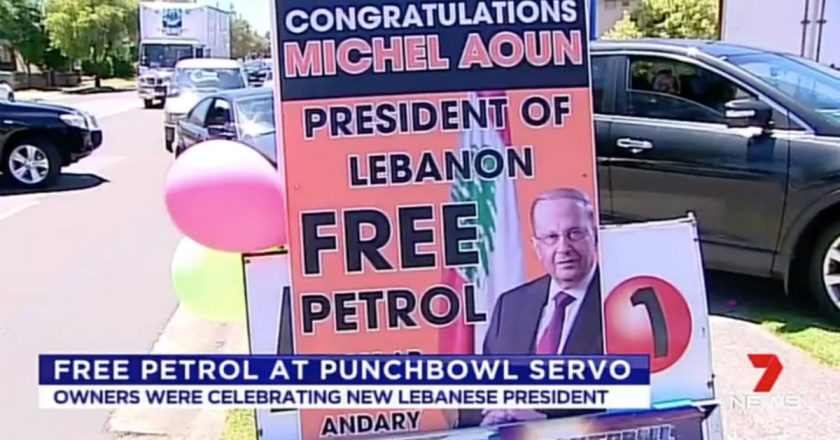
(SYDNEY, Australia) – Australian motorists were in for a surprise Wednesday when a Lebanese gas station owner offered free gas for an unlikely reason.

According to 7 News Sydney, the owner wanted to celebrate the appointment of General Michel Aoun to the Lebanese presidency.

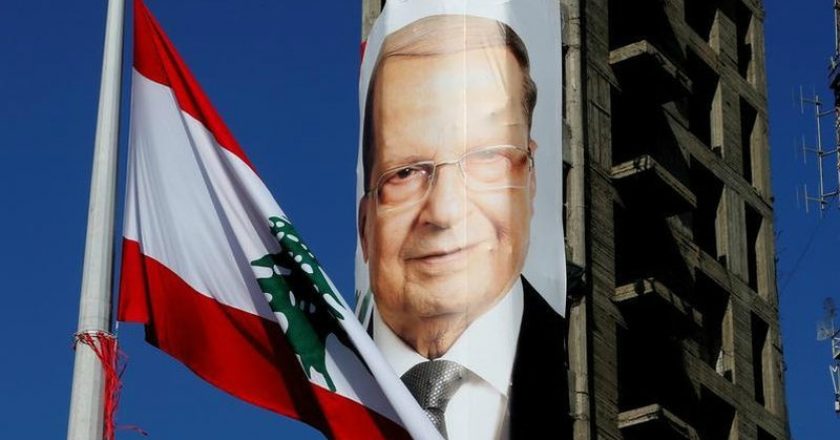
The deal was offered for about 30 minutes at lunchtime, and lucky motorists lined the streets to fill up their car. A photo of Aoun even overlooked the pumps!

WATCH:

Lebanon elects Michel Aoun as president; ends two-year stalemate

(BEIRUT) – Lebanon’s parliament elected former General Michel Aoun as president Monday, after a 29-month vacuum plunged the country into a political crisis and left citizens questioning the effectiveness of their government.

The 81-year-old Aoun secured 83 votes in the 128-seat chamber, giving him a majority to prevail against opponent Suleiman Franjieh, a fellow Maronite Christian.

Fireworks echoed across Beirut after the results were announced in a television broadcast from parliament. In his acceptance speech, Aoun called for the establishment of fair electoral law, and the implementation of the Taif accord to normalize Lebanese institutions.

In an unlikely agreement, Aoun was backed by many of his March 8 allies and former enemies, including Sunni leader and former Prime Minister Saad al-Hariri, a March 14 ally.

Under the agreement with Aoun, Hariri, whose business in Saudi Arabia is struggling, will likely become the country’s next prime minister.

Hariri said the endorsement came after he had exhausted all other options and was intended “to preserve the political system, reinforce the state, relaunch the economy and distance us from the Syrian crisis.

The unforeseen endorsements of Hariri, wartime enemies Samir Geagea, a rival Christian, and Druze leader Walid Jumblatt, gave Aoun enough votes to secure the race.

But Aoun had powerful adversaries opposed to his election, including Parliament Speaker and Shi’ite leader Nabih Berri.

Aoun notoriously led a “war of liberation” against the Syrian army in Lebanon in 1989-90, but reconciled with the Syrian leadership in 2005 after Syria pulled out of Lebanon.

He has been a strong supporter of Hezbollah’s involvement on the side of Assad in the neighboring country’s civil war, now in its sixth year.

“Aoun’s election is a clear victory for the pro-Iranian axis in the Levant and another climb down for Saudi Arabia,” wrote Paul Salem, vice president for policy and research at the Washington-based Middle East Institute.

Lebanon has been without a president since Michel Sleiman stepped down at the end of his term in May 2014, without an agreement on a replacement.

Aoun has been a running candidate from the beginning, and has refused to stand down in favor of  other candidates. Parliament has met more than 40 times since then, each time failing to elect a president because of a lack of quorum.

Many Lebanese citizens hope the election will reactivate the country’s political institutions and parliamentary restrains, which have been paralyzed by the crisis. The crisis has forced parliament to extend its own term twice, with the current one running until May 2017.

STAY WITH LEBANESE EXAMINER FOR UPDATES TO THIS BREAKING NEWS STORY.

Thousands of Lebanese rally for Christian politician Aoun

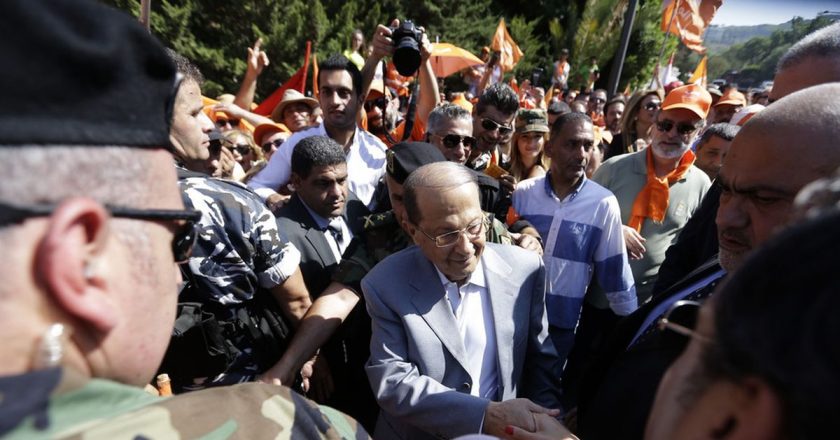
(BEIRUT) — Thousands of Lebanese rallied at the presidential palace outside Beirut on Sunday in a show of support for Christian politician Michel Aoun, pressing their demand for him to fill the presidency vacant for over a year.

Waving the orange flag of Aoun’s Free Patriotic Movement (FPM), they packed streets in the Baabda district that houses the headquarters of the presidency.

The presidency is set aside for a Maronite Christian but has been unoccupied due to a political crisis stoked by regional conflicts including the war in neighboring Syria.

“The president of the republic shouldn’t be just any person who fills the post, as some people want him to be,” Aoun told the crowd as his supporters shouted, “Aoun for president of the republic!”

“It should be someone who is like you, who reflects you and who rejects oppression and stands up for your rights,” he said.

The rally was called to mark events in October 1990, near the end of the Lebanese civil war, when the Syrian army captured Baabda and many Lebanese soldiers loyal to Aoun were killed.

Aoun – head of one of two rival administrations at the time – was forced out of the presidential palace and later into exile.

Aoun, an ally of the powerful Lebanese Shi’ite Muslim movement Hezbollah, has made clear he would like the presidency, but he lacks the backing of a rival alliance led by Sunni Muslim politician Saad al-Hariri.

facebook-button-d49e7af3899f10b12a7b14a5c8aa1873

That bloc includes prominent Christian rivals to Aoun, notably his civil war enemy Samir Geagea, who also seeks the presidency.

Aoun, who has argued that Christians are being politically marginalized in Lebanon, has said the president should be elected in a popular vote if parliament cannot agree.

Resolving the deadlock over the presidency has been complicated by regional rivalry between Saudi Arabia, which backs Hariri, and Iran, which supports Hezbollah.

Aoun has taken aim at the national unity government led by Prime Minister Tammam Salam, saying it has usurped the powers of the presidency. FPM ministers have not, however, quit the government.

Salam’s government, formed with Saudi-Iranian blessing, has spared Lebanon a complete vacuum in the executive arm but has been unable to take any major decisions due to a lack of consensus.

Lebanon’s political paralysis has fueled a broader wave of discontent that has touched off sometimes violent protests over failing public services in recent months. Anger came to a head this summer over a crisis over trash disposal that left piles of refuse mounting on Beirut’s streets.

REUTERS

Aoun supporters stage huge protest calling for new electoral law

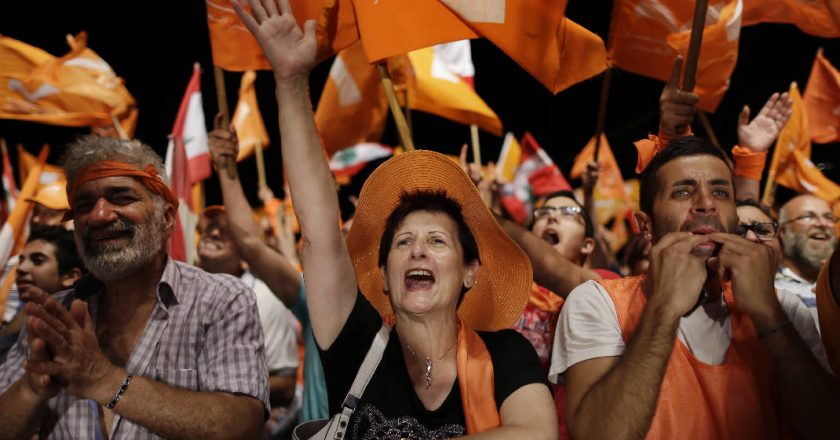
(BEIRUT, LEBANON) — Thousands of Free Patriotic Movement supporters staged a protest in downtown Beirut on Friday, to support Lebanese Christian leader Michel Aoun’s call for a presidential election by popular vote.

Aoun, who urged a heavy turnout at the protest, called for an end to presidential elections by parliamentary vote. He also invited FPM supporters to take to the streets “to call for fighting corruption.”

The sea of protesters waved FPM flags and held signs reading “At your service, General” and “We want new elections,” among others.

Lebanon has been without a president for more than a year because of a lack of quorum at parliamentary sessions. The 29th session will be held on September 30, but political analysts say the election of a consensus candidate is unlikely.

Aoun, a former army commander and presidential contender, is also protesting what he believes has been Christian “marginalization.” FPM supporters accuse Prime Minister Tammam Salam of usurping powers reserved for the president.

Foreign Minister Gebran Bassil, who recently won the FPM’s presidency uncontested, spoke at the rally and echoed Aoun’s remarks.

“They thought that they could force us out of political life and squares, but we returned to this square and we will return it to all Lebanese,” Bassil said, referring to Beirut’s Martrys Square, where the protest took place.

“They want to deprive us of the dream and our dream is to have a state, not a farm.”

Bassil told a cheering crowd of supporters that citizens should rally for a president and parliament that represents all religions and regions.

“We want a ‘clean’ president who does not cover up for corruption,” Bassil said. “We the Lebanese should elect our president, not foreign forces. We won’t accept a ‘wooden president’ who does not understand people’s golden equation.”

Friday’s protest come amid a wave of anti-government rallies in Beirut, sparked by the current government’s inability to solve the trash crisis. The protesters are led by civil society groups who are seeking to unseat a political system dominated by the same political parties since the civil war.

Lucien Bourjeily, one of the founders of the ‘You Stink’ movement, which has led the recent protests, said it was “absurd” that Aoun was protesting against the government which he is part of.

Lebanese officials react to Iran nuclear deal

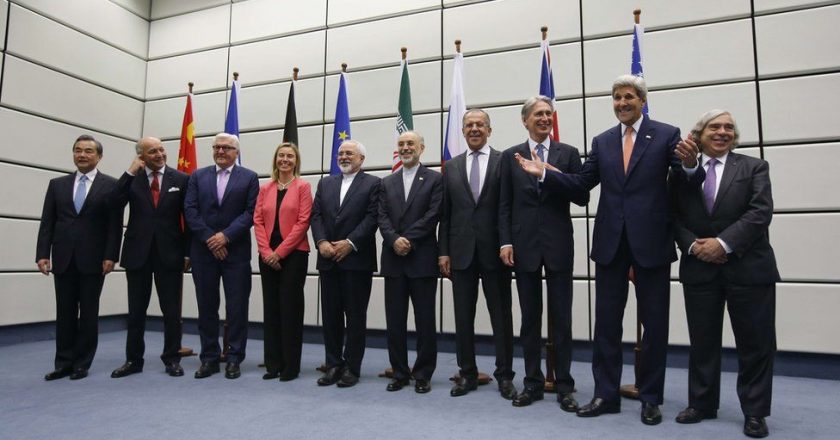
(BEIRUT, LEBANON) — Lebanese Prime Minister Tammam Salam and other Lebanese officials praised the deal reached between Iran and world powers Tuesday and expressed hope that the agreement would usher a new era of peace to Lebanon and the Middle East.

“We hope that this development will have positive repercussions on the situation in the Middle East, in a way that helps reduce tensions and spreads peace and stability,” Salam said in a statement.

Before the agreement was reached, Lebanese Parliament Speaker Nabih Berri said on Sunday that an Iranian nuclear deal could help pave the way to ending the presidential vacuum in Lebanon.

Other leaders from opposing parties also expressed their delight, including Free Patriotic Movement leader Michel Aoun, Marada Movement chief Sleiman Frangieh, and former President Michel Sleiman.

Lebanese Forces leader Samir Geagea and Progressive Socialist Party chief Walid Jumblatt were the only officials in Lebanon who spoke against the deal on Tuesday.

“Some have hopes about the nuclear deal but I disagree,” Geagea told reporters after meeting with Prime Minister Tammam Salam.

He said the deal is only a “mere agreement” and that it can potentially “aggravate” the situation in the Middle East.

Jumblatt said the deal “excludes Arabs…with total disregard for the Palestinian cause” and provided a “boost” to the “murderous” regime of Bashar Assad.

Under the deal, sanctions imposed by the United States, the European Union and the United Nations will be lifted, in return for Iran’s acceptance of long-term curbs on its nuclear program, which the West had claimed was aimed at creating a nuclear weapon.

The lifting of sanctions and the release of frozen assets in the United States will provide Iran with billions of dollars.

The former Iranian ambassador to the United Nations, Mohammad Sadegh Kharazi, was quoted as saying by The Guardian that the deal ended the “Cold War” between Iran and the United States.

Israeli Prime Minister Benjamin Netanyahu described the agreement as a “historic mistake” and said he would do what he could to block Iran’s nuclear ambitions.

“Iran is going to receive a sure path to nuclear weapons. Many of the restrictions that were supposed to prevent it from getting there will be lifted,” Netanyahu said at the start of a meeting with Dutch Foreign Minister Bert Koenders in Jerusalem.

“Iran will get a jackpot, a cash bonanza of hundreds of billions of dollars, which will enable it to continue to pursue its aggression and terror in the region and in the world. This is a bad mistake of historic proportions.”

Send this to friend